I'm a geek and embrace the science supporting yoga and share the most interesting tidbits with my students. It's too fascinating not to and since the more esoteric aspects of yoga has less potential to resonate with everyone, maybe science will.
I'm reading the Science of Yoga by William Broad, the same authored who penned the NY Times article, How yoga can wreck your body. Among the myriad of risks and rewards related to yoga, the risk associated with neck strain is most relevant to this posting. I always encourage my students to move with ease while maintaining the natural curves in the cervical (neck) and lumbar (lower back) spine. Looking around to see what the teacher or fellow yogis are doing distorts these natural curves , as well as optimal ranges of movement. The body can't release tension if we're creating it. It's a silly ego driven notion which doesn't consider whether or not the body is ready.
Some neurologists would argue that contorting (and holding) the neck for extended periods of time has the potential for more deleterious health risks such as strokes and impaired brain function. There are two vertebral arteries that run along the cervical spine and into the brain stem. They supply blood to the parts of the brain that are responsible for respiration, converting pulses into images and muscle coordination. Persistent or inappropriate movement in the cervical spine could pinch these arteries and reduce the blood flow to the brain. For example, think about the position of your head and neck in Bjuangasana (cobra pose). (NB Cobra pose is a back bending pose and as such the curve in the lumbar is deeper than neutral.) The image below is merely demonstrating different ranges of movement and remember what is appropriate for one yogi isn't appropriate for another other.
Another potential case of causing damage to the neck and consequently brain function can occur by moving into shoulder stand (Sarvangasana) or plow (Halasana). In this case, prolonged resting or moving inappropriately into these poses can damage or crush the cervical vertebrate thereby pinching the vertebral arteries or cause paralysis.
Remember these are extreme cases of the potential risks of an over-zealous practice or of moving inappropriately. My purpose was to share an interesting fact about human physiology and not to scare anyone. Practice with ahmisa (non violence) move within your optimal range of movement as you nourish a sense or relaxation, and ensure that you maximize the wonderfully healthful benefits of a safe yoga practice.
Namaste
Nancy-Anne
A tree-hugging biologist leaves the corporate world behind, and seeks to change the world through the yogic path of balance and love.
Sunday, May 24, 2015
Tuesday, March 3, 2015
Mantra. A means to stillness.
Stillness. What does it mean to you?
Stillness is a peaceful place and gets me out of my head and into the present moment. Sounds lovely doesn't? But stillness isn't always easy to achieve, trust me I'm a fidget. Connecting my breath to movement is a great moving meditation, and over the last few months, building mantra into my daily practice helps me achieve (some semblance of) stillness. I chant in the car, in my bed, running or while I wash the dishes.
My mantra meditation is largely Sanskrit. There is an intent and I like the sound of the chant and its effect on my body. In particular, I chant in honor and recognition of my Divine Self, that part of me that's beautiful and unique, my authentic self. Om Namaya Shivaya! I chant Guru Om to honor my teachers as well as the teacher inside, otherwise known as my gut feeling or intuition.
Other mantras are words of encouragement, when I'm running or riding up a hill I chant "I am strong! I am beautiful!' Or if the mental chatter is bothersome, I chant Let go. With an inhale I say let and with the exhale I say go. Completing malas is not mandatory for a mantra practice, make it your own. A few moments to chant (or even just to breathe) is all it takes maintain a place of stillness.
Mantra is etymologically and culturally Sanskrit and unsurprisingly the world's ancestors were on to a good thing. The underpinnings of mantra are also the basis for vibration therapy in that all matter vibrates at the same frequency and using resonant vibration brings matter back into balance. This is undoubtedly an oversimplification of vibration theory and mantra but I can't deny the sensations and emotions that often accompany my practice.
If your curious to learn more about mantra meditation consider this upcoming workshop Mantra Meditation at Samadhi Yoga and Wellness Centre.
Friday, June 6, 2014
As yoga becomes more popular and new styles emerge, a yoga teacher's priority should always be her students' safety and well being. Lately I've subbed for other teachers and I'm mortified to see how students move into and out of poses. I've also noticed that many students are unable to move through different poses without visual cues. Admittedly, I still demonstrate more than I should and it's something I work on in each class. I try to improve me cues and encourage my students to feel rather than watch. In doing so I hope to encourage my students to explore movement in their own body not mine or their neighbour's. I want them to have the confidence nd mindfulness to practice on their own. It also gives me the chance to see how my students are moving and how I can help them move more purely.
Understandably, when I sub a class I've a different style that might need some time getting used to but I wonder if there is a general lack of adaptability to a new teaching style, a resistance to change or perhaps my cues aren't as universal as they need to be. Then again, these observations are most obvious when I sub for a fitness based class such as power yoga. In these cases, some students react with complete disinterest to my gentler teaching style and others express their gratitude for a change in perspective.
Ultimately, it comes down to the intention of the student. I know why I'm there and I know what yoga means to me. If students practice yoga just for fitness then they are not the students for me. There's still a little girl that wants to be liked by everyone and to make everyone happy. As I mature, however, I realize that this is impossible and unnecessary. By trying to please everyone I sacrifice a bit of my authenticity and I did too much of that as a biologist. Not to mention the students I do have are the best ones in the world!!
Friday, May 2, 2014
santosha - contentment in the present moment
The present moment is once again a fine teacher. How often do you wish "if only..."? Or "All I need is..."
Instead, what if you take a moment to be grateful, content for what it is you already have or for who you are? It's a tricky thing to do, especially when we are constantly bombarded with images and messages telling us otherwise. We create impossible expectations which feeds our ego and drives the endless cycle of mental chatter and negativity.
The key to overcoming our discontent is the practice of santosha or contentment (one of five niyamas - yogic observances). Living in the moment is the first step to embracing this concept. The amount of time and energy I spend thinking about what could be, what isn't or who I'm not; and how little time I spend on who I am and what I have is shocking. It's an eye opener and enough motivation for me to LET GO of these attachments. I've so much to be grateful for and it's a disservice to myself and insulting to the amazing people I have in my life not to recognize just how blessed I am. I'm lucky to have a roof over my head and food in my kitchen. I'm loved and supported by my family and friends. I'm on an incredible journey of self discovery and healing, one of which I'm excited to share.
Be gentle with yourself. Recognize and take solace with the knowledge that you're not alone. Take the time to breathe into the present moment and let go your attachment to perfection, expectation and to anything but the truth.
You have all you need for happiness, right now. You don’t need to change anything about yourself, or your life. You just need to see what’s already there. - http://zenhabits.net/uncover-happiness/
Namaste
NA
Tuesday, March 18, 2014
Stop thinking, and end your problems. - Laozi
I'm a thinker. There's no doubt about that, which is why the following quote resonates with me.
"Every once in a while, when we catch ourselves running with a train of thought, we should stop and consider how we got there, what triggered the thought , and whether it’s worth staying with it. [Thought as a Sense]
As an academic it was my job and pleasure to think critically. But there is a BIG difference between thinking critically and over thinking. Despite the voice above the cacophony of mental chatter, telling me to chill out, breathe, let go, intense emotions of my passionate idealism often get the better of me and exacerbate a vicious thinking cycle.
“I think and think and think, I‘ve thought myself out of happiness one million times, but never once into it.” - Jonathan Safran Foer
Yoga and meditation are my salvation. Connecting with the breath and developing an awareness around sensation and emotion is about tuning into our intuition and listening to what our body is telling us. As part of a greater whole, we are infinitely wise and this collective wisdom is not found in politics, academia or even popular religious dogma. Of course, in reality, my over analytical brain often responds with "what is that feeling?" "what does it mean?" "why am I feeling this?"; and my superhero grip on attachments, especially the kind that doesn't serve me (are there any other kind?) keeps me stuck everywhere but the present moment.
Calming the mind and shifting from a "thinking place" to a "feeling place" is most definitely easier said than done, but it's all about the journey. And what a wild journey it is as I continually return and follow my breath wherever it may take me.
Happy mindful, travels!
Namaste
Nancy-Anne
Monday, February 17, 2014
somewhere on this journey...
Since my last entry, there was and continues to be a lot of learning and growing. The catalyzing lesson of 2013 was the power of authenticity. Of being yourself and of being present. The more time I spend in the moment, the more focused and confident I feel. And often the results are profound.When you live from one breath to another you create the space for things to happen as they are meant to, and the results are mind blowing. Of course this is much easier said than done and I'm always reminding myself that it's part of my journey.
The first step to realizing my authenticity was overcoming my fear of judgement and failure. Deep down I know these fears are unfounded and silly conquering these fears is not easy. The ego is a powerful beast but your breath is more powerful.When I connect with my breath, I'm gifted with a personal connection, sensation or something more tangible. At this point in my journey it's hard to articulate the reward but at the very least it's a renewed sense of confidence, an inkling of my potential. The icing on the cake? Everybody has their own fears and obstacles which they need to overcome. You aren't alone. And when we take the time to breath and hang out in the moment while practicing yoga or meditation you will not be disappointed.
So simply, slow down and see where your breath takes you.
“The privilege of a lifetime is to become who you truly are.”
― C.G. Jung
“Live authentically. Why would you continue to compromise something that's beautiful to create something that is fake?”
― Steve Maraboli, Life, the Truth, and Being Free
Wednesday, March 27, 2013
the power of your breath
![]() |
| psmag.com |
![]() |
| dailydownwarddog.com |
Find a comfortable seat or lie down and close your eyes. Take a few deep breaths by inhaling through your nose and exhaling a sigh. Settle in and clear you mind of expectations, preconceived ideas, stresses, worries and anything that doesn't serve you. Remember that it's your intention that's important. When you are ready inhale and exhale through your nose and allow your belly to gently expand with your inhale and flatten with your exhale. Stay calm and think of fluidity, softness, ease. When you are ready inhale through your nose and exhale your breath as a hum. Play around with the pitch of your hum and watch that you don't force it. Notice any sensations that arise. How does you body and mind respond to the gentle vibrations which your humming creates. We are unique individuals and each of us will feel and respond to brahmari breath (and yoga in general) differently. There's no right or wrong, it is what it is and in this yogi's opinion humanity's diversity is inspiring and worthy of celebration!
The benefits of Brahmari breath include relief from anxiety, depression, insomnia and restlessness, it builds confidence, improves memory and concentration and mitigates migraines. From a physical perspective, Brahmari reduces hypertension and lowers high blood pressure. Give it a try. Take the time to be curious and explore!
Tuesday, January 22, 2013
the fabulous majority!
Since so few of us fit into society's (read the media's) grand definition of beauty it seems reasonable to presume that there only a few yogis who are atypically bendy, and therefore capable of some of the more acrobatic poses. Popular yogis, like Rodney Yee was a dancer and a gymnast before he became a well known yoga teacher and practitioner Talk about an unfair advantage! Many everyday yogis are unable to complete a pose as demonstrated by yogi models, and I wonder how many of our favourite yogis are moving in pain or compensating their movement in one way or another.
Most of us have anatomical limitations stemming from tight or weak muscles, injuries and genetics which challenge our yoga practice. As such, we move in pain or compensate our movement to get into and out of some poses. I'm flexible which is helpful for getting into some poses, but there are poses for which I lack the muscle strength or congruency to do correctly. Instead of moving purely, and honoring where I am, I'll let my ego take over and simply flex my way through a pose.
Beauty, similar to how we look in our poses is an external characteristic and doesn't begin to describe our heart or our intention, that is our True Self. That said, challenging ourselves with poses IS fun, and the key is not to take it too seriously. I approach my poses from a "function over form" perspective which essentially boils down to adapting a pose to suit your body and mind to where you are in the present moment. I describe this perspective in terms of a spectrum, and I encourage my students to find where they are along it as we practice.
For example, Vrksasana (Tree Pose) is broken down into 1) balancing on one leg (right) and 2) externally rotating the opposite leg (left) in the its hip socket, and 3) lifting your (left) foot and placing it anywhere along the (right) balancing leg, except for the knee. The variations that define Vrksasana's spectrum is where you place your foot on your standing leg, whether or not you use your arm to lift and place your foot on your leg, and your arm variation (eg Warrior arms, Charlie's Angel, in prayer, hands on wait, T-position, eagle arms etc.). There are as many ways to express your Vrksasana as there are yogis, so have fun with it and get creative. Try introducing some flow into your pose by flowing from one arm variation to another, just remember to stay connected with your breath. Here are a few examples of where I fall on the Vrksasana spectrum:
Remember, yoga is a personal practice and the diversity among us physically, creatively and mentally is inspiring, extraordinary and worthy of celebration. Make each pose your own!
"The power of finding beauty in the humblest things makes home happy and life lovely." - Louisa May Alcott
Sunday, September 9, 2012
yoga for kids
Last month I attended an awesome workshop with Donna Freeman, an amazing and passionate woman who teaches yoga to kids. Our fun filled weekend together zoomed past and once again I'm left needing more! I am passionate about the environment, and my niece and nephew provide the impetus to fight ecological injustice and ensure that their children have a clean and healthy environment. And now thanks to Donna I have a new set of skills and the ability to share my passion for yoga with them. As adult yogis we are blissfully aware of the benefits of yoga and our kids deserve to reap those benefits too.
Yoga provides a fantastic foundation for child development because it refines their ability to express themselves, to concentrate and cooperate with their peers, as well as improve fine motor and locomotor skills. I had never thought about these basic skills that make us functioning Homo sapiens, largely because they are second nature, but it's a fascinating process. As an aunt, I absolutely love watching my niece and nephew discover the world around them. I love facilitating and then watching the "eureka!" moment.
A simple, secular approach to yoga philosophy teaches kids to be kinder, well rounded individuals through principles of non-violence, non-stealing, honesty, respect, compassion and patience. These principles are universal across the world's religions and are important characteristics for kids and parents to embrace. And most importantly, yoga gives kids an opportunity to be a kid, to have fun and be silly, the yoga teacher included!!
![]() |
| powerfulmothers.wordpress.com |
A simple, secular approach to yoga philosophy teaches kids to be kinder, well rounded individuals through principles of non-violence, non-stealing, honesty, respect, compassion and patience. These principles are universal across the world's religions and are important characteristics for kids and parents to embrace. And most importantly, yoga gives kids an opportunity to be a kid, to have fun and be silly, the yoga teacher included!!
Monday, August 27, 2012
ahhh...sana
I've also started to think about what causes my discomfort, how I can improve movement, and the difference between form and function. I can't address this in a single blog entry but it's certainly foremost in my mind when I practice and develop my classes. Lately, I'm thinking about how my cues land and how I can help my students find ease in their poses while improving their movement. But as always, I'm enjoying the challenge of sharing my revelations with my fellow yogis while refining my own yoga philosophy around some key principles of movement.
Labels:
anatomy,
asana,
ease,
Susi Hately,
yoga,
yoga therapy
Wednesday, June 6, 2012
peaceful mind, open heart
![]() |
| www.yogalifestudios.ca |
![]() |
| omtrekker.wordpress.com |
Asana and pranayama constitute most modern styles of yoga, thereby honoring the ancient practice of mindfulness by connecting the conscious (asana) with the
![]() |
| ahimsatrust.org |
The evolution of modern yoga is entrenched in an ancient history, and philosophical ideology which can't be summarized in a single blog entry. To truly appreciate its depth, beauty and authenticity, as well as to discover how and what resonates with you, a more thorough exploration of yoga's history and philosophy is necessary.
Books are infinite in number and time is short, therefore the secret to knowledge is to take only what is essential. Take what is essential and try to live up to it. - Sri Swami Vivekananda
How do you embrace the eight limbs of yoga?
Enjoy your exploration!
Namaste
Sources
Carrera, J. Rev. 2006. Inside the Yoga Sutras. Integral Yoga Publications, Buckingham, VA.
Iyengar, B.K.S., 2001. Light on Yoga. Thorsons, Hammersmith, London.
Jois, P.K., Yoga Mala. North Point Press, New York, NY.
Sparrow, L., 2008. Yoga. A Yoga Journal Book, Universe Publishing, Berkley, California.
Labels:
asana,
dharana,
dhyana,
eight limbs of yoga,
intention,
karma,
meditation,
niyamas,
Patanjali,
pranayama,
pratyahara,
samadhi,
Vedas,
yamas,
yoga,
yoga sutras
Thursday, May 10, 2012
yoga for your feet
Keeping our mind still and free from chatter and negative thoughts is challenging for everyone. Quieting my mind and centering myself are two reasons why I practice yoga, and although each day is different, lately I've been struggling with my balance. The foundational strength of our standing balance poses are linked to a number of physical, physiological and emotional factors e.g. tight hamstrings, an unstable pelvis, sleep deprivation, anxiety and depression. A consistent practice with careful attention to moving within our pain-free range of motion will undoubtedly improve our balancing poses, however; a little extra TLC such as toe yoga can go a long way too.
Come into Tadasana (Mountain Pose), stand tall, relax and a let your arms hang by your side. Ground the three corners of each foot equally into the earth. (The big and pinky toe pads as well as the centre of the heel represent the three corners of the foot.) Close your eyes, and imagine
inhaling length into your spine and exhaling into the space between each vertebra. With each full breathe ground your feet into the earth. If it helps, imagine there are roots growing from your feet deep into the ground. Stay in Tadasana for 5-10 breathes with the intention of grounding and balance starting with your feet, moving up your legs to your spine and core. Your arms, shoulders, neck and crown are relaxed and your mind is quiet. Inhale calm, exhale ease. Inhale smile, exhale release.
When you are ready, quietly come out of Tadasana and sit in a chair or on the floor, take your left foot into your lap, and give yourself a mini foot rub/reflexology session. I'd recommend using your favourite foot lotion, I like The Body Shop's Cooling Peppermint Foot Lotion. It feels good and you deserve it!! After a few minutes take your right hand and place a finger in between each toe. Spread your fingers separating the toes. Relax your fingers and spread them out again. Repeat these actions a couple of times and then use your hand to rotate your toes in circles. Makes sure to change directions after a short while. (Use your own discretion (intuition, desire etc) to determine how manyrotations you think your tootsies need.) Keep the rest of your foot relaxed
and ankle still. Once you have circled your toes in both directions, use your hand to rotate the entire foot starting with the ankle. You can do this with your fingers between your toes or with your hand. Before you switch and repeat these exercises on your right foot, feel free to massage your foot a few minutes more. Ahh... true bliss.
When you have performed foot yoga for both feet, come back into Tadasana. Take a few minutes to settle into this pose and take note of any differences you feel. Are you more aware of your feet on the ground? Do you feel more balanced? And even if you don't feel any differences, don't sweat it, nothing bad comes from foot rubs!
Thanks for reading! Namaste.
Come into Tadasana (Mountain Pose), stand tall, relax and a let your arms hang by your side. Ground the three corners of each foot equally into the earth. (The big and pinky toe pads as well as the centre of the heel represent the three corners of the foot.) Close your eyes, and imagine
inhaling length into your spine and exhaling into the space between each vertebra. With each full breathe ground your feet into the earth. If it helps, imagine there are roots growing from your feet deep into the ground. Stay in Tadasana for 5-10 breathes with the intention of grounding and balance starting with your feet, moving up your legs to your spine and core. Your arms, shoulders, neck and crown are relaxed and your mind is quiet. Inhale calm, exhale ease. Inhale smile, exhale release.
When you have performed foot yoga for both feet, come back into Tadasana. Take a few minutes to settle into this pose and take note of any differences you feel. Are you more aware of your feet on the ground? Do you feel more balanced? And even if you don't feel any differences, don't sweat it, nothing bad comes from foot rubs!
Thanks for reading! Namaste.
Labels:
balance,
feet,
grounding,
Mountain pose,
Tadasana,
therapeutic yoga,
toes,
yoga
Wednesday, April 4, 2012
less is more!
This March I spent an incredible 10 days workshopping the fascinating world of therapeutic yoga with Susi Hately. Saying that my world has changed would be exaggerating but in many ways it has. My biggest "a-ha" moment was the realization that slow, subtle movements will lead to faster progress i.e. pure movement. The subtlety and pace we (I) move through in life has a profound impact on the everyday and more momentous aspects of our (my) life. For those of you who know me, this is especially relevant. I move through life in a whirl, feet barely touching the ground. I'm always losing things, making silly mistakes and at the end of the day not feeling like I'm getting anywhere. The answer is simple. Slow down and move slower than what you think slow is.
This simple adage is integral to therapeutic yoga as it allows for greater ease in our classic asanas. By slowing down our practice, we are able to identify signals our body sends telling us that something is wrong e.g. pain, strain, twinge, popping, grinding etc. These signals or yellow lights tell us that we aren't moving in an optimal, pain-free range of motion. From a therapeutic perspective, we don't want to blow through these lights because we increase the probability of blowing past our
red lights which could potentially cause serious injuries. (Think back to the NY Times article questioning the safety of yoga.) Think of your optimal, pain-free range of motion as moving between your green and yellow lights. This analogy differentiates the therapeutic from the fitness based model of yoga. Neither is necessarily better than the other, rather they are dependent on a yogi's personal and fitness goals. Slowing down and listening to your body is also reflective of the yogic concept of ahimsa or non-harming stands reminds us to practice more mindfully and avoid hurting ourselves.
To demonstrate this new perspective on yoga, let's use Virabhadrasana 1 as an example. Please excuse the cluttered apartment and lack of photographic quality. I won't bore you with my excuses <cough> Mojo <cough>. From a fitness, intermediate yogi perspective, my Virabhadrasana 1 is fine. There aren't any visible alignment issues, and I'm (relatively) mobile. Admittedly, there was always a tweak or crackle here and there, and often an ache in my right sacroiliac joint (SI). Without too many details, my chest is a little tight which is why my elbows are near hyper-extension. If they were any tighter my
shoulders would be up by my ears. A shaky, unstable pelvis contributes to my SI ache, and my sore knees are in part attributable to years of hard work compensating for my Elvis pelvis.
My post-Susi Virabhadrasana 1 looks very different, and some may argue that it's no longer the same asana. And maybe they're right, but my goals and perspective have changed, and after a few customized exercises to address these issues my Warrior 1 one will be even better.
My teaching style will definitely evolve with this new information. I found myself cringing in some yoga classes before...
I think the real challenge will be breaking old habits and by slowing down I can already feel a difference and catch my self (almost) before a yellow light. If anything, I more excited about yoga and have found new inspiration to share with my students. Stay tuned and thanks for reading.
Breathing in I calm the body and mind
Breathing out I smile
Dwelling in the present moment
I know that this is the only moment
-Thich Nhat Hanh
This simple adage is integral to therapeutic yoga as it allows for greater ease in our classic asanas. By slowing down our practice, we are able to identify signals our body sends telling us that something is wrong e.g. pain, strain, twinge, popping, grinding etc. These signals or yellow lights tell us that we aren't moving in an optimal, pain-free range of motion. From a therapeutic perspective, we don't want to blow through these lights because we increase the probability of blowing past our
red lights which could potentially cause serious injuries. (Think back to the NY Times article questioning the safety of yoga.) Think of your optimal, pain-free range of motion as moving between your green and yellow lights. This analogy differentiates the therapeutic from the fitness based model of yoga. Neither is necessarily better than the other, rather they are dependent on a yogi's personal and fitness goals. Slowing down and listening to your body is also reflective of the yogic concept of ahimsa or non-harming stands reminds us to practice more mindfully and avoid hurting ourselves.
To demonstrate this new perspective on yoga, let's use Virabhadrasana 1 as an example. Please excuse the cluttered apartment and lack of photographic quality. I won't bore you with my excuses <cough> Mojo <cough>. From a fitness, intermediate yogi perspective, my Virabhadrasana 1 is fine. There aren't any visible alignment issues, and I'm (relatively) mobile. Admittedly, there was always a tweak or crackle here and there, and often an ache in my right sacroiliac joint (SI). Without too many details, my chest is a little tight which is why my elbows are near hyper-extension. If they were any tighter my
![]() |
| Pre-Susi Virabhadrasana I |
My post-Susi Virabhadrasana 1 looks very different, and some may argue that it's no longer the same asana. And maybe they're right, but my goals and perspective have changed, and after a few customized exercises to address these issues my Warrior 1 one will be even better.
![]() |
| Post-Susi Virabhadrasana I |
My teaching style will definitely evolve with this new information. I found myself cringing in some yoga classes before...
I think the real challenge will be breaking old habits and by slowing down I can already feel a difference and catch my self (almost) before a yellow light. If anything, I more excited about yoga and have found new inspiration to share with my students. Stay tuned and thanks for reading.
Breathing in I calm the body and mind
Breathing out I smile
Dwelling in the present moment
I know that this is the only moment
-Thich Nhat Hanh
Friday, March 9, 2012
sometimes less is more...
I subbed my first yoga class in Calgary and it felt great to teach again. Whether or not it will lead to something remains to be seen, but it doesn't really matter because I still love it! And as usual, I am feeling anxious and impatient because things aren't happening fast enough. However, the first bundle of courses with Susi Hately starts in 2 weeks, which doesn't help me patience-wise but makes me feel OK about my account balance.
Hmmm... looks like I'm going to be busy for along time!
Finances aside, I use my time wisely and take as many yoga classes as I can. The trouble is finding the right class with the right teacher. Calgary like most cities is saturated with yoga and it's hard to tease out the commercialism and pretense with the kind of yoga that I'm looking for. Lately, I've been having trouble finding a class that's challenging so I either take an Ashtanga class or do a double header - ah... the joys of unlimited time and an unlimited yoga pass. With all the training I plan to do I'm starting to wonder how I'll be able to maintain and challenge myself in my own practice. I imagine once I'm more financially stable I can try new studios and but when I really think about it there are a ton of poses that I still have to master, such as
| Visvamitrasana (yogajournal.com) |
| Hanumanasana (yogajournal.com) |
Pincha Mayurasana
(yogalifejourney.com)
|
Hmmm... looks like I'm going to be busy for along time!
Tuesday, February 14, 2012
Yoga in Cowtown
Well, here I am, in the big city. Not quite as overwhelmed as when I first arrived but I'm still adjusting. There are yoga studios everywhere and they offer classes all day! It awesome, I love it! There are classes and styles I haven't heard of before, and there's workshops happening most weekends. The classes are often huge in comparison to the classes I taught in Prince George and Cranbrook which is a little intimidating and if you don't have your mat you can rent one for the class. What?! Really? What happened to please wipe your mat down after you use it? Ah, well come to the city... :)
As a budding yoga teacher, it's hard not be hyperaware of how a class is taught and I often catch myself making corrections to a cue or how something is pronounced. I also take lots of mental notes about how I can incorporated what I'm learning into my own practice and future classes. I'm realizing that everybody makes mistakes! I already know that but I really want to be a great yoga teacher and like everyone else get caught up in the ego, but the deeper my practice becomes the more I recognize this. And the more classes I attend, the more confident I become because it funny when you tell your students to come into dead baby pose when you really meant to say happy baby or dead bug pose, just like it's funny when someone else gives the most anatomically impossible cue. It's yoga after all and my Self, the source of Light which I draw from has a great sense of humor.
It is better to do your own duty badly than to perfectly do another's. Bhagavad Gita
Thursday, January 12, 2012
Yoga an extreme sport?
Of course not but check out an awesome rebuttal by The Awl writer Sarah Miller
6 Reasons to Ignore the NY Times Yoga Article
Another great article by Sarah
Why Yoga Can be so Irritating
And Here's the original NY Times article
ENJOY!
6 Reasons to Ignore the NY Times Yoga Article
Another great article by Sarah
Why Yoga Can be so Irritating
And Here's the original NY Times article
ENJOY!
Distractions
I've been feeling pretty distracted lately... not so much from tangible things like Mojo playing with the string on my yoga pants or either cat resting on my back in any pose that allows it. But from the usual mental and emotional baggage that get in the way of the day to day, especially with my big move on the horizon.
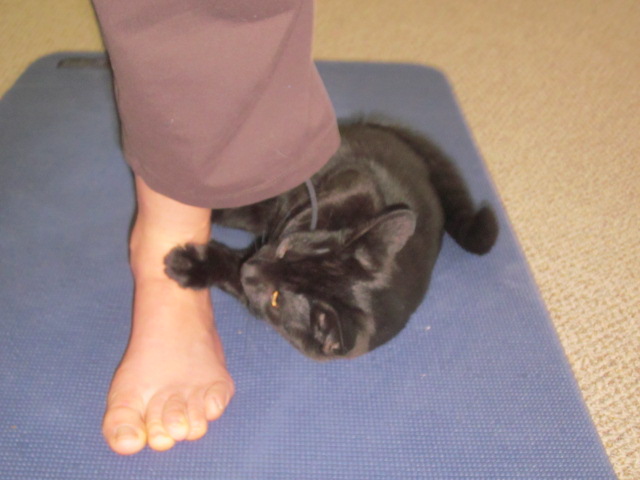
All the more reason to practice, and prepare. And try to tire the kitten out before I start practicing or should try and remain focused no matter what life throws at me as demonstrated in this funny video.
I could also just cut the single, non-functioning string from my pants but that would just makes sense!
I'm distracted by things like selling my truck and finding an affordable place but also by all the fantastic opportunities waiting for me. There are some workshops I'm planning to take in March, the first of many to becoming a therapeutic yoga teacher! How exciting!!
And then I get distracted over worrying about my teaching style... as many of you know I'm a mumbler and at times inarticulate. I'm also excitable and chatty but people come to my classes, and it is getting easier. When I first started training in Costa Riica I was overwhelmed with an incredible amount of new and fascinating information. Is till don't know what to do with it all! But I do know is that enjoy teaching and I'm really looking forward to growing as a yoga teacher and a life time student.
Wednesday, January 4, 2012
Trends and the high ground
Shit Yogis Say is a pretty funny video by Lululemon in response to a PR project gone bad. I remember when Lululemon was a small store on 4th (or was it Broadway) in Vancouver. The clothes were cute and expensive but not overly so. You didn't mind spending the money because you knew you were paying for quality and something somewhat unique. I don't begrudge Lulelemon's success, it is a Canadian company which is awesome and their clothing is high quality, but I resent the inaccessibility of quality products and services to those of us who can't spend $100 on a pair of yoga pants. I think this is attributable to the popularization of yoga and is evident in other trendy items such as iPods or X-boxes. Unlike these technological gadgets, yoga has the potential to heal society's mental and physical ailments and in my utopian worldview anything that heals or just makes people the world a better place should be accessible to everyone!
This is of course more of a rant since yoga is fairly accessible through online streaming (see Yogis Anonymous and YogaGlo), DVDs, books and classes at community centres. And sometimes I find myself belittling the trend setters and questioning their motives because yoga isn't about how good you look. It's about being in the moment and surrendering our attachments to materialism. "Letting go of that which doesn't serve you." is another important aspect of yoga and criticizing other people's choices and reasons for doing whatever doesn't serve me in the least! In fact it's not very yogic at all. It's just like what the yogis say "Nobody owns yoga!"
And hell yeah I saw his handstand!
Sunday, January 1, 2012
New Beginnings
Happy New Year!
I'm glad 2011 is behind me, just like I was glad 2010 was behind me and so on... So what have I been doing wrong to feel so unsatisfied? I could ramble on analyzing and debating the potential reasons but that would and has got me nowhere. It's time to take action and this year that means BIG change.
I am an Ecologist by trade and more importantly PASSION. Unfortunately, in my experience that isn't enough to make in the real world, maybe in a perfect world but not this one. In all fairness, there are fabulous people doing awesome things and I WILL continue to crusade for the planet. I am a tree hugging hippy and that will never change. I'm just changing my approach and taking my passion for yoga to a new level.
Last February, I went to Costa Rica for an intense 3 week yoga teacher training course with Frog Lotus Yoga (http://www.froglotusyoga.com/.) Needless to say, it change my life and after a year of teaching part-time I've decided to pursue a career as a teacher and yoga therapist! I LOVE it and I'm so excited to get started. The first step is to move to the city where there are more studios and opportunities to advance my own practice and learn the fine art and science of yoga therapy. So look out Calgary (YIKES!!) here I come!
Subscribe to:
Posts (Atom)


.jpg)